


Summary
-
A brief introduction to what a criminal background check is and why it is important for employers.
-
It typically covers areas such as FIR records, legal proceedings, serious offences, criminal cases, as well as court judgements and convictions.
-
Basic distinction between a criminal background check and a general background check.
A curated list of the types of criminal checks in India and a deep dive into the common misconceptions.
A step-by-step process on how to integrate background checks in the hiring workflow.
Conclusion
Introduction
Hiring today is not just about skills and experience but also about trust. With organisations becoming more digital and distributed, employee risk is quietly emerging as one of the biggest blind spots while hiring. A single bad hire can expose companies to financial loss, compliance failures, and brand image damage in the long run.
This is why criminal background checks have moved from being a nice-to-have to a business requirement, especially in India’s high-volume hiring environment. With fraud becoming more sophisticated and court records increasingly digitized, employers can no longer afford to skip criminal checks or treat them as a formality.
In this guide, we have discussed what a criminal background check is, what it covers, how it differs from general background verification, and how organizations can integrate criminal checks into their hiring workflow effectively.
What is a criminal background check?
The process of verifying whether a candidate has any criminal history recorded in any of the official databases is known as a criminal background check. These records include criminal cases, FIRs, court proceedings, or convictions registered with Indian authorities.
In simple terms, it helps employers answer one critical question: Does this candidate have a legal history that could pose a risk to the organization?
In India, criminal record checks rely on multiple data sources such as court records, police databases, and FIR systems. With increasing digitization, many of these checks can now be performed digitally instead of relying on slow, manual police verification processes.
Complete BGV in 5 days with zero fraud assurance?
Why do employers conduct criminal background checks?
Every organization, regardless of industry, handles some form of sensitive data, financial assets, customer interactions, or internal systems. The risk exposure increases with an undisclosed legal history of the employees. Here are multiple reasons why employers should conduct employee criminal background checks:
1. To reduce fraud risk
According to IDfy’s 2025 annual fraud report, fraud is no longer limited to document forgery. Legal history risks have increased significantly across industries, especially in BFSI, insurance, telecom, and IT/ITES.
In sectors where employees handle customer data, money, or compliance-sensitive operations, even one fraudulent hire can lead to large-scale damage.
2. To protect customers and internal teams
The roles that involve customer interaction, field operations, logistics, and other fields that require a high degree of trust must undergo a criminal background check. Criminal checks ensure that no fraudulent employee gets access to the sensitive data.
3. To meet regulatory requirements
In regulated sectors like BFSI, fintech, healthcare, and telecom, criminal checks are not just a necessity but mandatory. Non-compliance can lead to penalties, audits, and reputational fallout.
4. To prevent insider threats
According to IDfy’s annual report, over 20% of data breaches in high-risk sectors are driven by insiders and not external factors. It also acts as the first line of defense against potential insider threats.
What does a criminal background check cover?
A criminal record check in India typically covers the following areas:
-
Criminal cases: Active or historical criminal cases registered against the individual in Indian courts.
-
FIR records: First Information Reports (FIRs) filed at police stations, including pending complaints and investigations.
-
Court judgments and convictions: Final verdicts, acquittals, or convictions issued by courts.
-
Legal proceedings: Ongoing civil or criminal proceedings where the candidate is a party.
-
Serious offenses: Cases involving fraud, financial crimes, violent offenses, sexual offenses, cybercrime, or identity-related fraud.
It is important to note that not all criminal records carry the same weight. Employers must assess the nature of the offense, the recency of the case, the relevance of the role, and the Legal outcome (convicted vs acquitted). Criminal checks should be about contextual risk, not just blanket rejection.
Criminal background checks vs general background checks
Many employers confuse criminal checks with a complete background verification. However, they are not the same. A criminal background check is a subset of a broader background verification process. We have done a detailed distinction between the two:
| Criminal Background Check | Full Background Check | |
|---|---|---|
| Legal History |
Legal history is of primary focus. |
Covers everything such as: identity, education, employment, address, and references |
| Documentation |
Verifies criminal cases, FIRs, and court records |
Verifies credentials as well as professional claims |
| Risk Assessment |
Helps to assess legal and safety risk |
Helps in assessing overall candidate credibility |
| Turn Around Time (TAT) |
Requires 1 day for assessment |
Requires full 7-10 days for complete BGV |
| Essential for roles |
Critical for trust-sensitive roles |
Essential for every role |
In short, criminal checks answer whether the person is criminally risky, while background checks answer whether the person is truthful and qualified, and both are equally important. However, criminal checks specifically protect organizations from legal, safety, and reputational threats.

Types of criminal background checks in India
Criminal background checks in India are not a single process. They are conducted through multiple verification layers, each with different turnaround times and data sources.
-
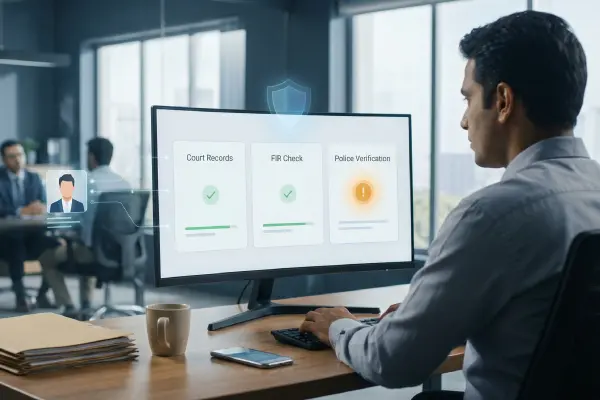
Court record checks (eCourts): Court record checks verify whether a candidate has any criminal or civil cases registered in Indian courts. These checks rely on digitized court databases across district, high, and supreme courts.
The turnaround time for this check is near-instant to same-day and is best for all roles, especially BFSI, IT, insurance, and telecom sectors. Court record checks are the backbone of modern criminal verification in India.
-
eFIR checks: eFIR checks verify FIR records filed across police stations. With the increase in digitization, many police departments now maintain online FIR databases. The turnaround time for such checks is instant to a few hours. This check helps in detecting the early-stage legal complaints, and is best for customer-facing, sales, logistics, and field roles. eFIR checks help catch candidates with unresolved or hidden legal issues before they escalate into serious risks.
-
Police verification (PCC – Police Clearance Certificate): Police verification involves manual confirmation by local police authorities based on the candidate’s address and identity. The turnaround time for the same is 15 to 45 days and is mandatory for roles that are in government and other regulated industries. While PCC is still used in some cases, it is slow, manual, and not scalable for modern hiring. Most enterprises now rely on digital court and eFIR checks instead.
Common misconceptions about criminal background checks
Despite their importance, criminal checks are often misunderstood. Here are some common misconceptions.
- Criminal checks are only for senior roles: It's always perceived that criminal checks are mostly for senior roles; however, risk is not related to a job title. Entry-level roles with customer access or financial systems often carry higher risk than leadership roles.
- Police verification is enough: Many organisations think that police verification is enough; however, police verification is slow and limited. Digital court and FIR checks provide deeper and faster coverage.
- Criminal checks delay hiring: There is no delay when it comes to being cautious. Modern digital criminal checks run instantly and do not affect hiring speed. In fact, they save the time that organisations have to spend otherwise if the employee turns out to be a fraudster and causes monetary and reputational damage to the organisation.
- One criminal case means automatic rejection: Employers must evaluate severity, recency, and role relevance. The context of the crime is equally important.
How to integrate criminal background checks in your hiring workflow
One of the biggest mistakes organizations make is running criminal checks too late. By the time onboarding starts, recruiters have already invested time, money, and effort into the candidate. Modern hiring workflows integrate criminal checks early in the funnel.
Step 1: Pre-interview screening
Instant criminal checks should be run before the interviews. This filters out high-risk candidates early and also prevents wasted interviews.
This is where solutions like IDfy First Impression become critical. Recruiters can verify identity, court records, eFIRs, and fraud databases within minutes, even before the onboarding is done.
Step 2: Pre-offer verification
For shortlisted candidates, it's imperative to run a deeper criminal and legal check along with education and employment verification.
Step 3: Risk-based decisioning
Criminal results should not be treated with a binary lens. Internal policies must exist to define what kind of offenses are unacceptable, which roles require a zero legal risk, and which cases need additional review.
Step 4: Continuous monitoring
Risk does not stop after onboarding; continuous monitoring is important, especially for high-trust roles. Continuous monitoring helps detect new legal issues that emerge after hiring.
According to IDfy’s annual report, 1 in 3 individuals with a criminal history are repeat offenders. In such cases, continuous monitoring acts as a long-term safety net.
Criminal checks in high-risk industries
- BFSI: This sector has the highest legal history risk across industries. Even a single bad hire can expose banks to compliance violations, financial fraud, and regulatory penalties.
- Insurance: Advisor networks and field agents pose a serious risk. IDfy data shows that thousands of fraudsters in insurance roles had open criminal cases, including financial crimes and identity fraud.
- IT and ITES: With increasing insider threats, criminal checks protect organizations from data breaches, cyber fraud, and intellectual property theft.
- Telecom : Employees handle SIM data, customer identities, and network access. Criminal checks in this sector prevent insider-driven data breaches.
India’s hiring ecosystem has changed drastically. Today, it incorporates remote interviews, digital documents, AI-generated certificates, shell companies, and fake experience networks, among other risks associated with hiring. According to IDfy’s 2025 fraud report, companies lost over ₹150 crore to employee-linked fraud enabled by weak verification systems. Waiting until onboarding to detect legal risk is no longer acceptable.
Conclusion
Criminal background checks are no longer optional. They are a core pillar of modern hiring. In a world where fraud is automated, documents are forged at scale, and insider threats are rising, trust must be verified early, digitally, and continuously.
Organizations that integrate criminal background checks into their pre-interview and pre-offer workflows do not just reduce risk. They build stronger teams, protect customers, and create a safer workplace culture.
The future of hiring in India is not about speed alone. It is about speed with legal certainty. If you are also looking for a BGV partner for a smoother, faster, and fraud-free onboarding for your organisation, do reach out to us at shivani@idfy.com. Our team will get in touch with you for all your BGV concerns.
IDfy’s BGV Cost Calculator
Estimate how much a background check costs with the industry’s lowest TAT and amber rate for your organization. Fill out the form to get the quote directly to your mailbox. Get instant price estimates based on your organization’s BGV needs, exclusive offers from IDfy, and free trial packages of IDfy’s BGV services.